El video d'una campanya de WWF-Brasil en contra de la deforestaci'o a l'estil de les maquines de Rube Goldberg:
D'altres campanyes de WWF i similars a la web de scaryideas.
diumenge, 28 d’octubre del 2007


dilluns, 22 d’octubre del 2007
Eliminar anuncis i coses rares
Un dels problemes més habituals amb el PC és la quantitat de porqueria que sense que ens n'adonem entra al nostre PC: anuncis, cookies, malware, spyware, i un llarg etcètera.
Hi ha una eina molt potent per a detectar i eliminar aquest tipus de coses: el SpyBot Search & Destroy.

Atenció!!! Aquesta aplicació NO és un antivirus, és un complement a l'antivirus.
Entre d'altres, presenta dos avantatges:
- és gratuït. En la web de descàrrega podeu fer donatius (no és broma, no! És gratis).
- Només funciona quan l'engega un usuari. *
*Bé, això també suposa un problema perquè si no l'engegués mai ell solet no fa res.
USUARIS AVANÇATS
Una altra funcionalitat que presenta (que de moment no he provat) és la de fer backups del registre de windows(!).
Aquesta funcionalitat no només és útil per a lluitar contra l'Spyware, sinó que també serveix per a fer punts de recuperació abans d'instal.lar software nou.
Hi ha una eina molt potent per a detectar i eliminar aquest tipus de coses: el SpyBot Search & Destroy.
Atenció!!! Aquesta aplicació NO és un antivirus, és un complement a l'antivirus.
Entre d'altres, presenta dos avantatges:
- és gratuït. En la web de descàrrega podeu fer donatius (no és broma, no! És gratis).
- Només funciona quan l'engega un usuari. *
*Bé, això també suposa un problema perquè si no l'engegués mai ell solet no fa res.
USUARIS AVANÇATS
Una altra funcionalitat que presenta (que de moment no he provat) és la de fer backups del registre de windows(!).
Aquesta funcionalitat no només és útil per a lluitar contra l'Spyware, sinó que també serveix per a fer punts de recuperació abans d'instal.lar software nou.
dimecres, 25 de juliol del 2007
Cristina, Jaume, Anna, Juliana i Sempruniana
Felicitats!!!
Per cert, abans de començar amb 'la guassa', Juliana i Sempruniana són Les Santes!
Per cert, abans de començar amb 'la guassa', Juliana i Sempruniana són Les Santes!
dimarts, 8 de maig del 2007
dilluns, 7 de maig del 2007
Errors de càlcul
Un altre servei que ens brinda internet és el de trobar tota la informació que volguem. Un exemple, fa temps (uns deu o quinze anys) vaig veure la crònica de com uns americans s'encarregaven de treure una balena morta varada a la platja. Tenia ganes de recuperar-lo o si més no tornar-lo a veure. Avui el meu desig s'ha fet realitat.
Per a tots vosaltres: The infamous exploding whale.
Per a tots vosaltres: The infamous exploding whale.
I també podeu veure el video de l'explosió de la balena.
(PAUL LINMAN) It had to be said,
the Oregon State Highway Division
not only had a Whale of a problem
on its hands, it had a stinking
whale of a problem: what to do
with a one 45 foot 8 ton whale
dead ????? on a beach near Florence.
It had been so long since a whale had
washed in the beach on ?????? that
nobody could remember how to get rid
of one. In selecting his battl plan,
the Highway division decided the
carcass couldn't be buried because
it might soon be uncovered, it
couldn't be cut up and then buried
because nobody wanted to cut it up
and it couldn't be burnt so
dinamite it was with 20 cases or
half a ton of it. The hope was
that the long ???? pacific gray
whale would be almost disintegrated
by the blast and any small pieces
still around after the explosion
would be taken care of by seagulls
and other scavengers. Indeed the
seagulls had been standing nearby
all day.
As everything was being made ready
we asked GEORGE THORTON (?) -the
Highway engineer in charge of
the project- for his final
observations.
(GEORGE THORTON) Well, I'm
confident that it'll work the only
thing is we are not sure just exactly
how much explosive it will take to
disintegrate this thing so the
scavengers and seagulls and ??????
??? ??? clean it up.
(PAUL) Is there any change that
it might more than a one day job?
(GEORGE) Aaah, if there's any
large chunks left and... ah, we
may need to do another clean-up,
maybe set another charge.
(PAUL) The dinamite was buried
primarily on the ???? side of
the big mammal so as most of the
remains would be blown towards the
sea.
About 75 by-standers, most of them
residents who had first found the
whale to be an object of curiosity
before they tired of its smell,
were moved back a quarter of a mile
away. The sand-dunes were covered on
spectators and land-lover newsmen,
shortly to become land-blober
newsmen. For the blast blasted
blober beyond all believable bounds.
8...7...6...5...4...3...2...1...
KaBoom
Wee! Yeah! Oooooh! Ha hah...
¿OMG?¿WTF?
(PAUL) Our camera stopped rolling
immediatelly after the blast. The
humour of the entire situation
suddenly gave away to a run for
survival as huge chunks of whale
blober fell everywhere. Pieces of
meat passed tight over our heads
while others were falling at our
feet. The dunes where rapidly
evacuated as spectators escaped
both of falling debris and the
the overwhelming smell.
A parked car about a quarter of
a mile from the blast site was
the target of a one large chunk,
the passenger compartment
literally smashed. Fortunatelly
no human was hit as badly as
the car, however everyone on
the scene was covered with small
particles of dead whale.
As for the success of the effort,
the seagulls who were supposed
to ????? things up were nowhere
in sight either scared away by
the explosion or kept away by
the smell. That didn't really
matter, the remaining chunks were
of such a size that no respectable
seagull would have ???? ??? anyway.
As darkness began to set in, the
Highway crew were back on the
beach burying the remains
including a large piece of the carcass
which never left the blast site.
It might be concluded that should
a whale ever wash in shore in
????? again, those in charge will
not only remember what to do, they'll
certainly remember what not to do.
diumenge, 29 d’abril del 2007
Bici
Amb el bon temps arriba la temporada de bici.
Avui, primera presa de contacte, sortideta suau amb dona i cunyat:
Avui, primera presa de contacte, sortideta suau amb dona i cunyat:

dissabte, 21 d’abril del 2007
RSS (I)
Incís tècnic
(Atenció, aquest article/tutorial només és útil si useu un navegador Firefox o bé l'Internet Explorer 7. Si useu Internet Explorer, qualsevol versió, us recomano Firefox. No he usat mai ni Opera ni Safari)
NOTA: el logo de RSS està generat a partir del SVG de la Wikipèdia.
Fi incís tècnic
 Des de fa temps, existeixen planes web que sindiquen el seu contingut. Això facilita a l'usuari el saber quan hi ha un contingut nou. De tota aquesta tecnologia se'n diu RSS.
Principalment, naveguem per internet per (1) a buscar informació puntual, (2) compartir els nostres interessos o bé (3) llegir sobre actualitat. Per al segon i al tercer cas, acostuma a passar que anem moltes vegades a les mateixs planes web per a mirar quins informació ha aparescut nova, quins són els últims titulars del dia, etc. Per a aquests casos, els servidors acostumen a publicar la informació en HTML (plana web normal i corrent) o bé en RSS (un format diferent). A continuació us ensenyo la diferència entre els dos formats: el blog en format HTML (el que veieu habitualment)
 el blog en format RSS (tal i com el mostra Firefox 2)
La primera diferència està en què l'HTML mostra el contingut (la informació) amb un conjunt d'estils que fan que tot sigui més maco per a la vista. Mentre que l'RSS només mostra la informació tal i com és i en alguns casos, només es mostra un petit resum.
La segona diferència la podem veure en la manera d'afegir la plana als nostres bookmarks o favoritos (no sé com se'n diu en català). Quan accedim a una plana que publica el contingut en RSS apareix una petita icona taronja a la barra de navegació (en versions antigus d'Internet Explorer no, poseu-vos Firefox!) com la que us mostro a la dreta: Podem afegir un favorito en HTML usant el menú de bookmarks.
O bé podem usar la icona de RSS per a tenir un favorito dinàmic.
La gràcia del bookmark que us mostro en l'anterior captura de pantalla és que cada vegada que jo afegixi infomació al blog, el desplegable mostrarà els nous articles que s'hagin afegit al meu blog!. En el meu cas, com que el blog canvia poc, no és massa important, però si sou fans de llegir els titulars de premsa de digital podeu subscriure-us als RSS de La Vanguardia o de El Pais (ElMundo.es NO té RSS, per assumptes de publicitat...).
De tota aquesta història dels RSS també se'n diu sindicació.
De moment, aquesta és la introducció als RSS. En un proper article us explicaré què són els lectors de RSS.
(Atenció, aquest article/tutorial només és útil si useu un navegador Firefox o bé l'Internet Explorer 7. Si useu Internet Explorer, qualsevol versió, us recomano Firefox. No he usat mai ni Opera ni Safari)
NOTA: el logo de RSS està generat a partir del SVG de la Wikipèdia.

Fi incís tècnic
 Des de fa temps, existeixen planes web que sindiquen el seu contingut. Això facilita a l'usuari el saber quan hi ha un contingut nou. De tota aquesta tecnologia se'n diu RSS.
Principalment, naveguem per internet per (1) a buscar informació puntual, (2) compartir els nostres interessos o bé (3) llegir sobre actualitat. Per al segon i al tercer cas, acostuma a passar que anem moltes vegades a les mateixs planes web per a mirar quins informació ha aparescut nova, quins són els últims titulars del dia, etc. Per a aquests casos, els servidors acostumen a publicar la informació en HTML (plana web normal i corrent) o bé en RSS (un format diferent). A continuació us ensenyo la diferència entre els dos formats:
 el blog en format HTML (el que veieu habitualment)
 el blog en format RSS (tal i com el mostra Firefox 2)
La primera diferència està en què l'HTML mostra el contingut (la informació) amb un conjunt d'estils que fan que tot sigui més maco per a la vista. Mentre que l'RSS només mostra la informació tal i com és i en alguns casos, només es mostra un petit resum.
La segona diferència la podem veure en la manera d'afegir la plana als nostres bookmarks o favoritos (no sé com se'n diu en català). Quan accedim a una plana que publica el contingut en RSS apareix una petita icona taronja a la barra de navegació (en versions antigus d'Internet Explorer no, poseu-vos Firefox!) com la que us mostro a la dreta:
 Podem afegir un favorito en HTML usant el menú de bookmarks.
 O bé podem usar la icona de RSS per a tenir un favorito dinàmic.
Si cliquem en aquest quadrat taronja, se'ns afegirà una entrada als bookmarks que durà per nom "el nom del meu blog" però que serà desplegable: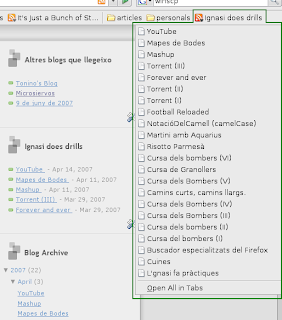 Un bookmark dinàmic gràcies a RSS.
 Un bookmark dinàmic gràcies a RSS.
La gràcia del bookmark que us mostro en l'anterior captura de pantalla és que cada vegada que jo afegixi infomació al blog, el desplegable mostrarà els nous articles que s'hagin afegit al meu blog!. En el meu cas, com que el blog canvia poc, no és massa important, però si sou fans de llegir els titulars de premsa de digital podeu subscriure-us als RSS de La Vanguardia o de El Pais (ElMundo.es NO té RSS, per assumptes de publicitat...).
De tota aquesta història dels RSS també se'n diu sindicació.
De moment, aquesta és la introducció als RSS. En un proper article us explicaré què són els lectors de RSS.
Subscriure's a:
Missatges (Atom)